This post is the first of a new series examining a work by Pablo Picasso. For more explanation see the introduction in Un-painting Picasso.
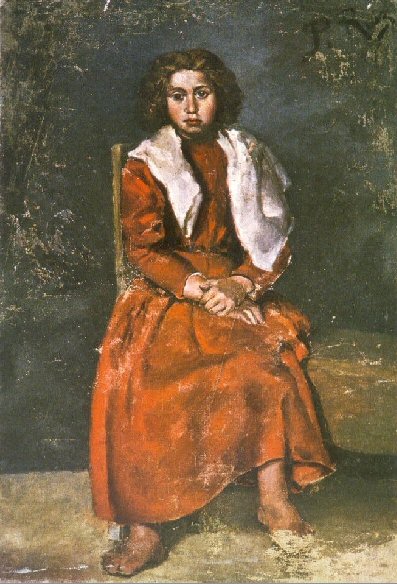
When Picasso was 10 years old his family moved from Malaga, his birthplace in exotic Andalucia, to LaCoruña in Galicia on the forbidding North West Atlantic coast of Spain north of Portugal. Under the tutelage of his father, he painted this portrait of La fillette aux pieds nus when he was still only 13 years old!
In this extraordinary painting, done especially by someone as young as he, the ability to observe and render such complex emotion forecasts his exquisite portraiture and intense interest in society’s marginalized members.
After the death of Picasso in 1973, Patrick O’Brian CBE (born in 1914 as Richard Patrick Russ, uncle to Elizabeth Russ) the English novelist and translator, best known for his Aubrey–Maturin series of novels set in the Royal Navy during the Napoleonic Wars, was authorized to publish his “Pablo Ruiz Picasso a Biography” in 1976. Fortunately for us, O’Brian was not allowed to publish reproductions of any art works, leaving him the task of describing the specific works before discussing them. About La fillette aux pieds nus he wrote:
She sits on an uncomfortable straight-backed chair against a broken dark green background, dressed in a long russet frock with a white cloth over her shoulders, her hands folded in her lap and one large chilblained foot dangling. She is a sad child, deep dismay struggling with sullenness in her face at repose: dismay not at her present situation, but at the world into which she has been pitched. She is of about the same age as the painter, and she sits there patiently; her immense, lustrous, asymmetric eyes gaze forward, a little down, at nothing. Here the technique is surer still, the brush-stroke firm and decisive on the dress, gentle and flowing on the face; and here there is much more personal involvement. Picasso did not spare her big hands, thick ankles, and coarse great feet; he was not the least concerned with prettiness; but it was evident, not merely from her eyes and the pure oval of her face, that he was entirely with her. p.38 (O’Brian. Pablo Ruiz Picasso a Biography. G.P. Putnam’s Sons: New York. 1976.)
Another testimony to the brilliance of this painting is from the 1985 Musée Picasso Guide. Hélène Seckel, curator, said that the early paintings of Picasso demonstrate an absolutely stupefying skill. Some of the elements in this unconventional portrait are very striking … the bare feet swelled with inflamed sores, her large inelegant hands and her asymmetrical, bloated face. These are fascinating observations!
This painting continues to be referenced to this day. In his latest work “L’Eclaircie”, called a “beautiful book” by Marc Lambron in Le Point, french novelist/poet Phillipe Sollers writes, “la magnifique Fillette aux pieds nus (1985), dont la robe rouge et l’écharpe blanche ancrent le visible et la vie avec même majesté que le grand cèdre du jardin.”
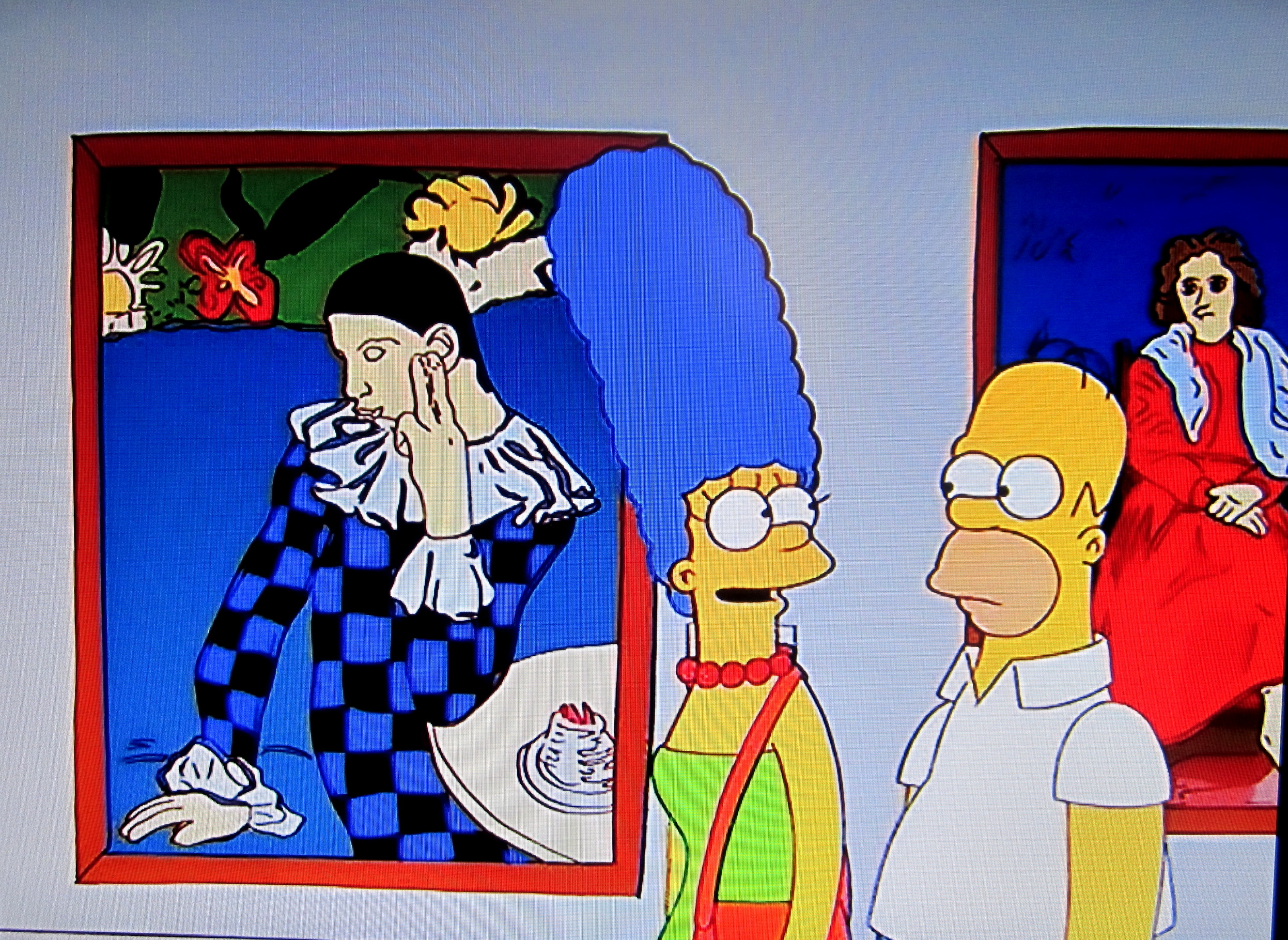
And, if this isn’t enough, the extraordinary writers of the Simpsons made this painting part of Homer’s education in the history of modern Art!
 she paints; she is a painter
3 responses to “Un-painting Picasso: La fillette aux pieds nus”
Neat that your art curiosities have led you to Picasso. A group of us went on Tuesday as a mini-occasion honouring Linda Blix. Very interesting exhibit and well laid out.
I’ve enjoyed your blog on this particular painting and your thoughts – always entertaining!
LikeLike
Hi Pat,
Yes, this is a fantastic portrayal of a young girl. I wonder if Picasso painted this after his sister Conchita’s death in 1894. His lifelong attention to the darker, complicated sides of life (death, sex, aggression, conflict) as well as his sensitive portrayal of what a human body, not only looks like, but feels like, is certainly already present here. Gitte.
LikeLike
This series is very interesting. Thanks for directing it to us. How astounding that Picasso was able at this young age to capture so much depth of emotion and pathos in a work.
LikeLike