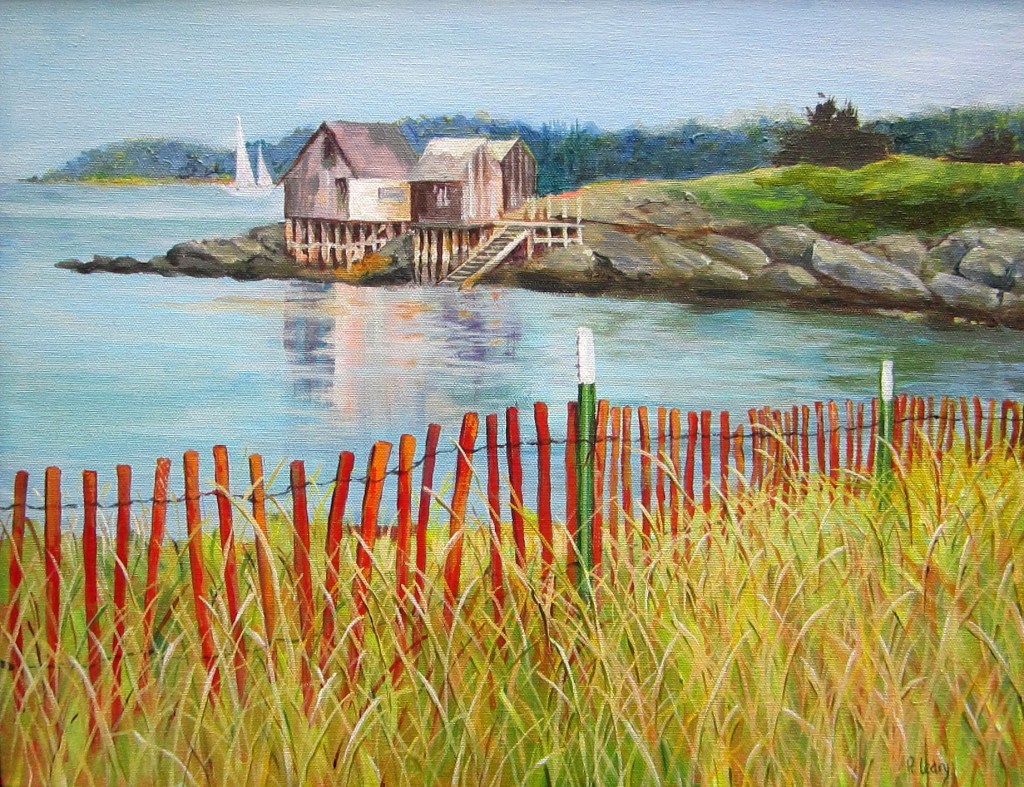
Almost two years have passed since I started this blog and I am still showing you paintings from 2004; nevertheless, I’m determined to finish this chronology! Still with the very early acrylics … this time featuring Fall at Willard Beach, the local beach where I grew up in South Portland, Maine. As I previously explained about some learning techniques in my next to last post, this painting was done from a photograph I took with my brother, Mike, in 2004. I’m still early on the learning curve of painting with acrylics here; however, even though it seems a little bit of a cliché of Maine with the fishing shacks and the sailboat, this painting is special to me for all the powerful memories it evokes.
Now, I’d like to take you back with me to 1958. If you’re willing to come along, click on the read “more” and we’ll go there together.
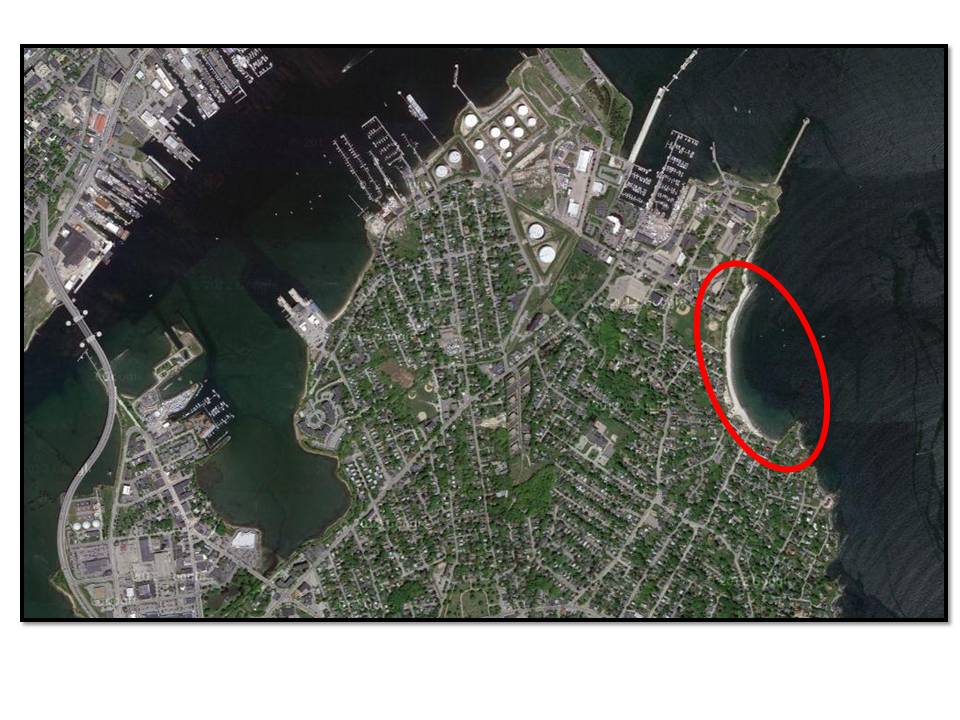
First of all the scene in this painting does not completely conform to my memory. There had been neither sand fencing nor beach grass. When I tried to find information about the history of the beach, I got happily immersed for more hours than I care to admit in the relatively new website of the South Portland Historical Society. Then more hours with The Maine Geological Survey gave me further information about the underpinnings of the beach, where I’ll start my story …
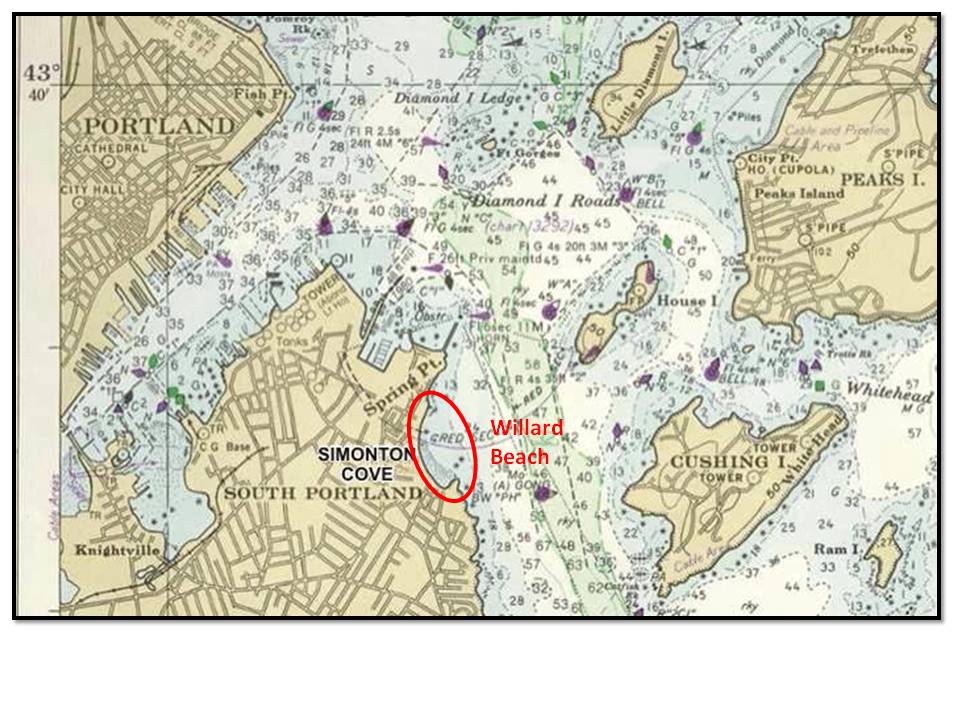
Being one of the very few urban beaches in Maine, Willard Beach occupies a unique status. With nature’s clever design the 4 acre, sandy crescent is limited to the north and to the south by natural boundaries of bedrock headlands. Even though the beach and dune system is relatively protected by the Casco Bay islands (click on map to enlarge), extensive use over the last 100 years of commercial fishing, recreational boating and sun bathing had prevented the natural vegetation and dune formation. Furthermore, buildings were erected very close to the sand to the extent that some were partially built on stilts to protect them from the encroaching tides. In 1896 a casino was erected at the end of Willard Street where a trolley transported the “city people” from Portland to enjoy the gambling and the beach. The casino was razed by fire two years later but trend to the beach was established.
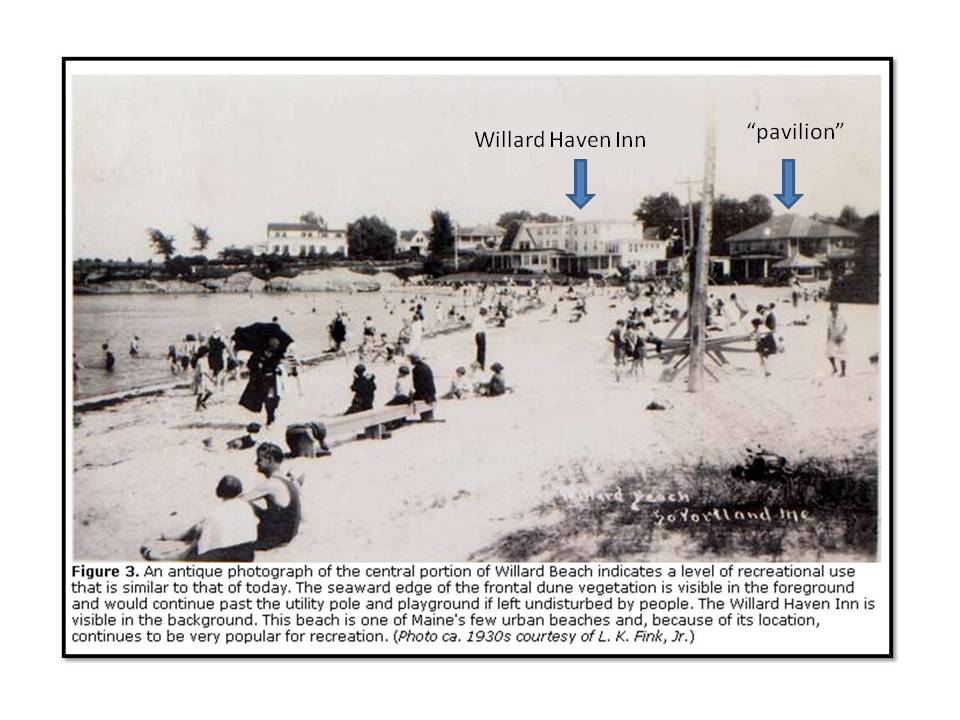
The 1930s view below, courtesy of the Maine Geological Survey, showing the vitality of the many beach goers and the buildings which sustained them, resonates more to me as the view I remember in 1958 than the painting from 2004.. The southern headland can be seen at the water’s edge on the left. The see-saws were still there when I was a very little girl, but the most important images are those of the Willard Haven Inn and the Pavilion.
Here’s a close up, courtesy of the South Portland Historical Society:

Yes , the Willard Haven Inn … this is where I started my independent life. In the summer of ’58 I had my Social Security card. This means that one is officially allowed to work. (Up to this point I had worked for cash at the local farms, weeding and picking string beans for which we were paid 2 cents a pound!) With that SS card in hand I answered an advertisement for a position as kitchen help at the Inn. Of course, I had no experience and I was a “petite” little person. Nevertheless, for whatever reason I”ll never know, the cook hired me, provisionally.
The kitchen with its south-east exposure was flooded with light and warmth. And, my enthusiasm was also sunny, but soon the reality shook my own underpinnings. I was mainly responsible for preparing vegetables for the cook and keeping all the materials clean. I learned some valuable skills like the proper way to chop masses of onions, with the large curved chopping knife. One holds the top of the tip with the flat open palm of the left hand and then using the handle like a lever with the right hand, one rocks the blade up and down over the onions many, many times until they are minced! Peel potatoes and carrots, chop green peppers and garlic! I thought I learned it all, but maybe not to the satisfaction of the cook. And, what about that cook? I don’t remember too much about him except for a powerful, fiery impression. At the time he seemed middle-aged, but was probably only in his 30s. Muscular, stocky, wiry and redhead! Being both rebarbative and irascible, he scared me to tears most of the time. “Never put a dish wiper on your shoulder”! “Hurry up with those onions”!! … How long did I last in this job? I don’t remember exactly, maybe a month. The best part of working in that kitchen was quitting time, because I could walk over to the pavilion where many of my high school friends who lived in the neighborhood would be “hanging out”, Carolyn, Rita, DB, or CER.
It was the classic 50s establishment: pin ball machines, a jukebox, a soda fountain and a concrete floor large enough for dancing, if one was in the mood. It didn’t matter if you walked in with wet, sandy bare feet, no one cared. You could lie on the beach and listen to the Everly Brothers, Chuck Berry or Connie Francis, (not that I liked her), smell the sea air and feel the sun. This was like being in another world, especially since I lived on the other side of South Portland. It was another world.
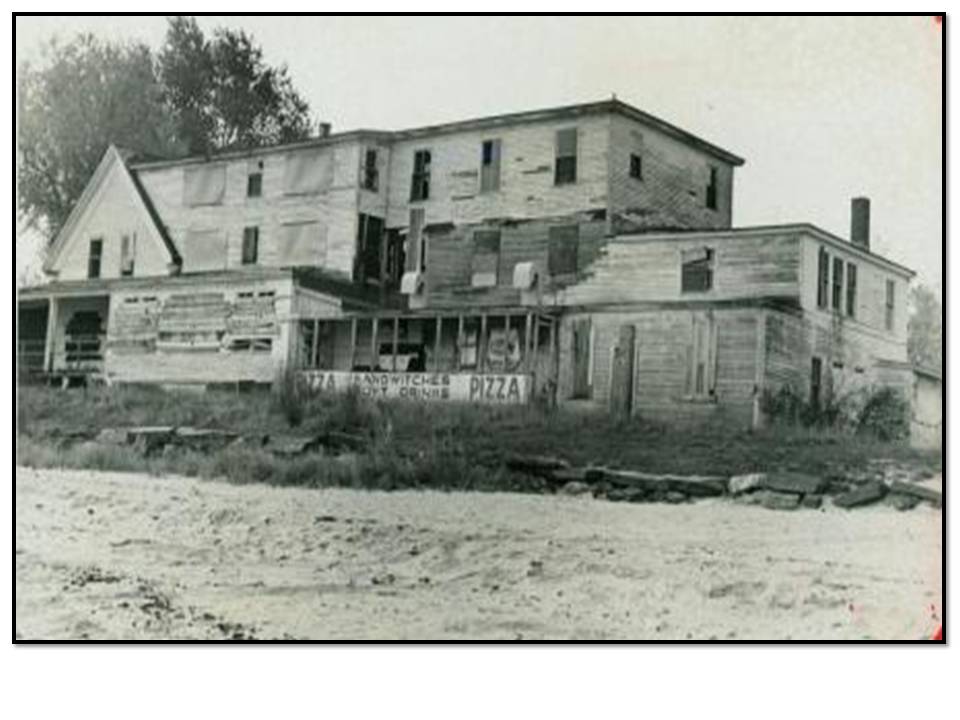
Back to reality … I was shocked to see this photo from the Maine Historical Society below of the poor old Inn as it looked before its destruction in the mid 60s. Maybe the building was already very sad in my 1958 experience, but in my memory the Inn was a grand, grand place.
After the demise of the public buildings, the beach became more gentrified. In 1986 a citizen-led beach management initiative organized an effort to stop erosion with the addition of sand fencing and the reduction of foot traffic. These measures are allowing the dunes to return and the coastal flooding to be decreased. The Maine Geological Survey posts a very nice history with maps and photos of this successful conservation effort.
Now you know why the painting at the beginning of this post is filled with beach grass and sand fencing. More importantly, you know why I love Maine and Willard Beach. Now, I live far away and do not visit Maine very often.
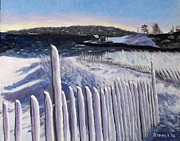
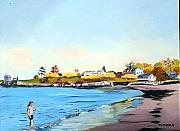
Some people who were not born in Maine are the fortunate ones who can choose to live there. One such person is Jack Riddle. He is a prolific painter originally from New York City who demonstrates his love of Maine through his art. I was pleased to see his charming paintings of Willard beach in winter (Shown below). If you would like to see more of Jack’s paintings, click on his link above.

 she paints; she is a painter
8 responses to “#20 Willard Beach; Still 2004”
Bittersweet memories…. I was enjoying the story about the grand old Inn and it was a shock for me also to see it in decline. It was the same in B.C. – the salt sea air and stormy oceanside takes its toll. Lox
LikeLike
PS – forgot to say I really admire your acrylic rendition!
LikeLike
I really liked reading this post, Pat. I guess they were ” not YOUR onions”.
Like Lizzie, I liked the acrylic also.
LikeLike
I love how you use colour in your paintings. How wonderful to do all that research to learn about the history of the beach. You are both inquisitive AND determined. I too was shocked to see the building’s state prior to being demolished. Change can be sad.
LikeLike
Pat,
I love your Fall at Willard Beach. What warm yet dazzling colour!
LikeLike
Your paintings are absolutely gorgeous even if I don’t know the area. Keep on painting. You are raw talent….
LikeLike
Awesome painting!
She writes more than she paints 😀
LikeLike
Love the fall colours..Joy
LikeLike